

Solutions
Solutions
Two entry points
Two ways in
A cabinet manufacturer, a retail fit-out contractor and a distributor buy the same fixture for different reasons. One specification is written with the furniture, one has to match a drawing, one has to repeat across a catalogue.
So the range is reached two ways. By customer type, if the question is how you buy. By application, if the question is what the light has to do where it is fixed.

Light customization is evaluated from 50 pieces per model and works on a proven platform, so no new mould is needed. Minimum order, sample terms, lead time and delivery basis are confirmed for each product and project.
By customer type
Six groups buy differently
Each group is a page of its own, and each answers the same three questions: what this buyer has to decide, what the range offers for it, and what to send so the answer comes back usable.
- 01 Cabinet & furniture manufacturers Lighting designed into the cabinet, specified with the hardware and delivered with the furniture order.
- 02 Display & retail providers Shelf, case and showcase lighting for retail fit-outs, where colour and brightness hold across a run.
- 03 Lighting designers & contractors Components that have to match a drawing: colour temperature, output, sensing, cable length and mounting.
- 04 Distributors Repeatable product lines for a catalogue, with labels and packaging prepared for the channel.
- 05 Stores & showrooms Mixed smaller orders across cabinet, wardrobe and display lighting, sourced from one supplier.
- 06 Small brands Products supplied under your own brand, without building a factory or a tooling programme first.
By application
Five scenes we are asked about
An application page starts from the installation: the fixing, the cable route, the switching logic and the surface the light lands on. The fixture follows from those, not the other way round.
-
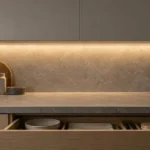
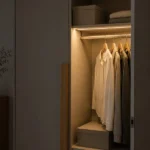
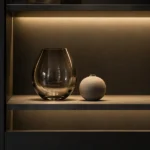
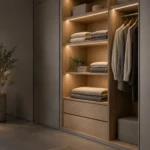
Cabinet & furniture lighting
Under-cabinet runs, in-cabinet lighting and wardrobe interiors.
-
Display & showcase lighting
Retail cases, showcases and display walls.
-
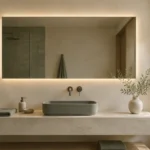
Mirror lighting
Backlit mirrors in bathrooms and dressing areas.
-
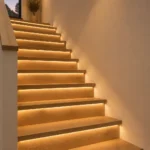
Stair lighting
Tread and riser lighting for interior stairs.
-
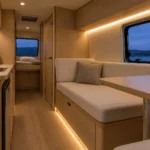
Marine & RV lighting
Low-voltage lighting for boats and campervans.
Choosing
Which path first
Both paths end at the same categories. What changes is the question you answer first, and therefore the questions we come back with.
Start from your trade when the product already exists in the project: a model number, a sample the client approved, a series already on site. The customer type page sets out how that product is supplied to you — standard, lightly customized, or under your own label.
Start from the application when the space is fixed and the light is not. The scene decides the fixing height, the beam, the cable route and the switch, and those points narrow the range faster than a product name does.
- A model, a sample or a competitor product in hand: start with the customer type.
- A drawing or a cavity to fill: start with the application scene.
- Both known: send the drawing and the quantity together, and state which parts cannot change.
- Neither settled: the category pages show the shapes that exist before anything is specified.
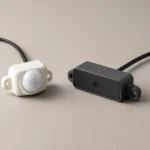
Sensing changes the answer more than any other option. A door switch, a motion sensor and a hand-wave sensor are triggered by different things, are wired differently and are mounted differently. The control methods compared.
Before a quotation
Three points settled first
A solutions conversation is short if these three are already clear. If they are not, they are the questions that come back before any price is written.
-
01
Which part of the chain you need
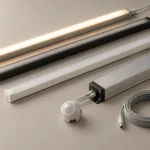
The fixture alone, or the fixture with its driver, sensor, cable and mounting parts. A light quoted without its driver is a different quotation.
-
02
Quantity and order shape
Light customization is evaluated from 50 pieces per model, on an existing product rather than a new mould. Minimum order, sample terms and lead time are confirmed per project, never assumed.
-
03
Market requirements
Voltage, certification, freight, duties and lead time are confirmed for the destination at inquiry. A document shown for one market is not carried over to another.
Where the two paths meet
What the two paths share
Most projects use both routes: the scene fixes the light, the buyer type fixes the specification, the quantity, the sample and the branding.
Product requirements, certification and freight are confirmed per destination and per model. A statement that holds for one market is not carried over to another.
Next step
Send the space, not a product name
A drawing of the cabinet, a photo of the display case, or the application you recognise is enough to start. We answer with the category that fits, the parts it needs and the questions that remain.